Blog7 min read
The retro Bollywood AI photo trend, and what the search data really says
For the past few weeks the strongest search signal anywhere near 1990s India has not been a song, or a serial, or a snack. It has been people asking Google Gemini to make a retro Bollywood photograph of themselves. Usually in a saree. Usually lit like a still from an old film.
We found this while doing keyword research for this site, and it was not what we went looking for. So here is what the data shows, what it very much does not show, and the one thing about it that we cannot explain.
What "retro Bollywood" means in a search box right now
We pulled Google Trends for India on 13 and 14 August 2026, past twelve months, web search, across thirty different search terms.
The term "retro bollywood" has exactly one rising related query attached to it. One. It is "gemini ai photo".
The rising related topics for the same term are Classic car, Lighting, Linen, High-rise and Sari. Read those five words again in order. That is not a list of films or actors or years. It is a list of things you would type into a prompt: a car to stand next to, the quality of the light, a fabric, a building, a garment.
The term "90s nostalgia" says the same thing from a different angle. Its rising queries are "create", "gemini" and "google gemini". Its rising topics are Aesthetics, Retro style and Sari.
Two separate searches, arriving at the same place.
What these numbers are, and what they are not
This part matters, and most write ups skip it.
Google Trends does not publish search volume. It never has. Every number it gives you is relative, scored from 0 to 100 inside that one search term's own set of results, and those scores cannot be compared between two different terms. A 100 on one chart and a 100 on another chart are not the same amount of anything.
"Breakout", which is the label attached to "gemini ai photo", is a growth flag. It means something rose very fast from a very low starting point. It says nothing at all about how big that thing is now. A term can be a breakout and still be tiny.
So here is what we can honestly say. Within the pool of people searching "retro bollywood" in India, the fastest growing thing they also search for is Gemini photo generation. And here is what we cannot say. How many people that is. We do not know. Nobody has published it, and we are not going to invent a number.
One more caution, from our own capture. We loaded the same Trends page twice in a row and got slightly different lists back. Treat this as indicative rather than exact. One of the rising topics under "90s nostalgia" is a film called Bright, which almost certainly has nothing to do with any of this. The data is not clean.
The part that does not fit
Now the interesting bit.
One of the standard things said about this whole nostalgia wave is that it is a reaction against the AI internet. The appetite is supposed to be for things that feel messy and handmade and made by an actual person. That reading is part of why the barbershop music sites travelled so fast in August.
Except the sites in that wave are almost all AI illustrated, and a lot of them look AI coded from a template, which is fairly obvious once you look at how these sites are actually put together.
And now the biggest live search signal sitting next to the same aesthetic is people generating AI photographs of themselves.
We saw a sharper version of the same contradiction in a July 2026 thread on r/IndiaNostalgia, a subreddit of about 62,000 members. Someone posted an AI generated image of a 1990s Indian living room: a wooden CRT television with the Doordarshan ident on the screen, a mantel clock, a stack of cassettes labelled with serial names. Laid over the top of it was a line of AI written Hinglish sentiment about how Sunday was not just a holiday but a feeling.
Thirty eight comments. One person attacked the caption, in those words: "I hate ai's dialoguebaazi man". Another person asked to be put inside the picture. Nobody attacked the picture.
That is one thread and one comment, so on its own it proves nothing. But it points in the same direction as the search data.
A hypothesis, and we are labelling it as one
Here is our reading. It is a hypothesis. We are not presenting it as a finding, because we have one page of search data and one Reddit thread, and that is nowhere near enough to conclude anything.
People seem to accept AI as a mirror and reject AI as a narrator.
As a mirror, AI shows you your own face in another decade. You supply the subject. The machine supplies the light, the saree, the Ambassador parked behind you. No claim is being made about the past. It is closer to putting on a costume than to making a statement.
As a narrator, AI tells you what your past was and what it meant. That is where the objection lands. The picture of the living room was welcome. The sentence explaining what Sunday felt like was not, and the person objecting was very precise about which half of it he minded.
There is a reason the second half stings more in India specifically. This generation's memory of the 90s is unusually uniform, because it was issued rather than chosen. One broadcaster, one schedule, one cheap cassette catalogue. If everybody was handed the same childhood, then everybody is an authority on it. That is why the commonest reply to a nostalgia post is not agreement but a correction about which day a show aired, and it is the same reason so many people remember exactly the same thirty songs. An audience like that will let a machine draw the room. It will not let a machine tell it what the room meant.
What would prove this wrong
If we are going to float a theory, we should say what would sink it.
It fails if someone finds a nostalgia post where an AI generated image gets attacked as hard as AI written copy does, in a comparable thread with comparable numbers. It also fails if the retro portrait trend produces a visible backlash of its own, with people posting that they are sick of a timeline full of generated sarees. That would suggest the tolerance was never about mirror against narrator, and was only ever about novelty that had not worn off yet.
It is weakened, too, if the Gemini signal turns out to be about something else entirely. Trends shows us that two terms rose in the same period. Rising together is not proof of the same behaviour. We are inferring the saree portrait from a list of topics, not from watching anyone make one.
Nothing here is a verdict on the people making them
Worth saying plainly, because this subject attracts sneering from both directions.
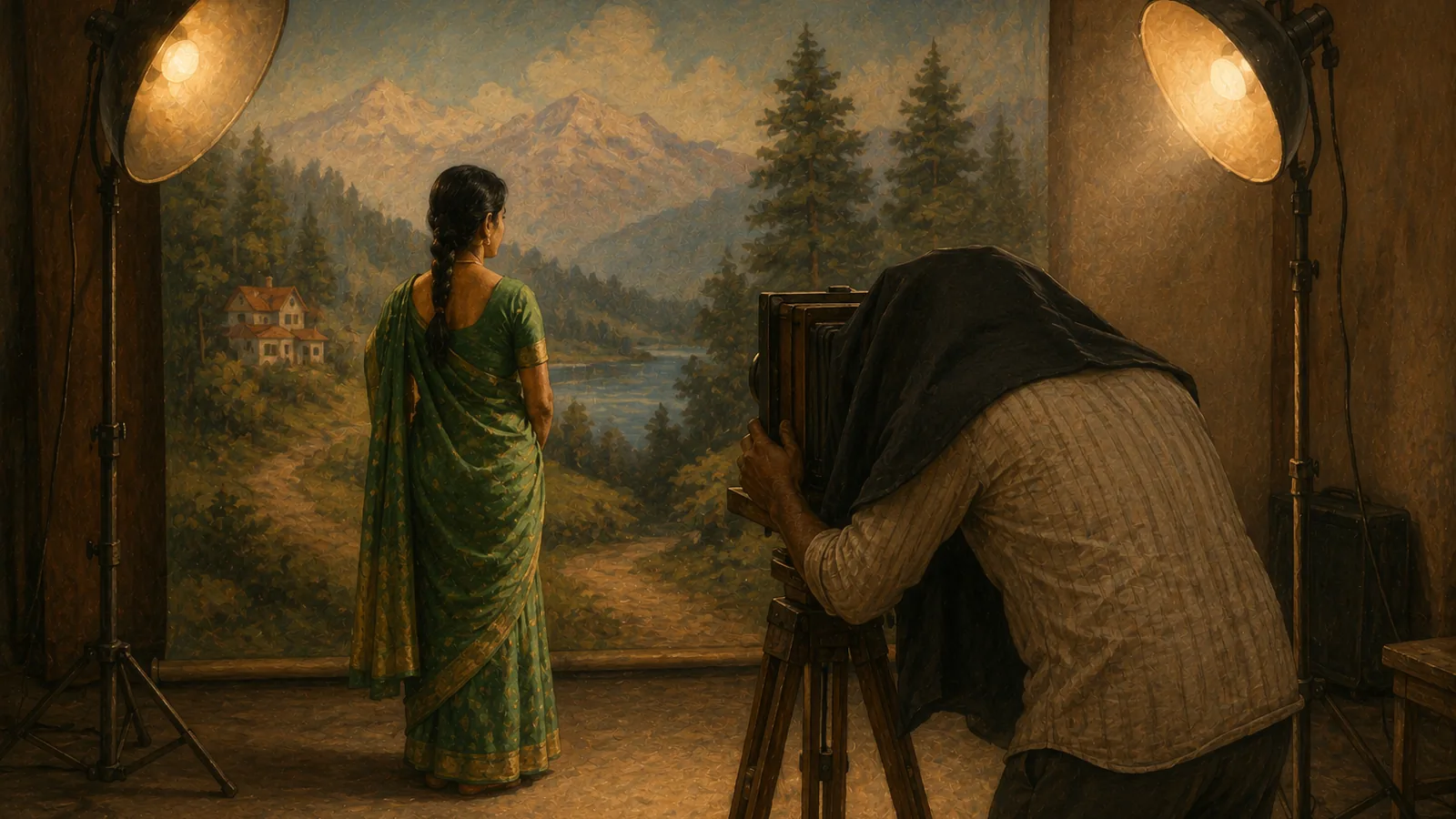
Making a picture of yourself in a 90s saree is a small, cheap, harmless pleasure. Nobody is deceived by it. It sits in a long line of exactly the same instinct: the studio portrait with a painted hill station behind you, the wedding album, the photo booth at the fair. Indians have been paying to be photographed inside a nicer version of the world for as long as there have been cameras here. The backdrop used to be canvas. Now it is generated.
It is also not a movement. It is a fast growing search term of unpublished size, captured on two days in August. If you want a sense of how much of this wave is real audience and how much is builders copying builders, the running list of the sites themselves is a better place to start than a Trends chart.
What the chart does tell us is narrower and more useful. When Indians reach for the 90s online in August 2026, a growing share of them are not reaching for something to listen to or read. They are reaching for something to look like.