Blog7 min read
A Guide to the Desi Nostalgia Microsites
In August 2026 people started opening a browser tab, hearing a Kumar Sanu song, and feeling eleven again. The desi nostalgia microsites are one page websites that play the songs you never chose. The barbershop radio. The conductor's tape deck. The dhaba speaker at 2am.
There are around twenty now, and they are not the same. Here is which is which.
saloon.wtf, the one that started it
Yash Bhardwaj, a developer in Mumbai, posted saloon.wtf on 8 August 2026 with one line of description. It plays songs from Indian barbershops, he said, from before you became fancy and started visiting salons. That post crossed 1.6 million views.
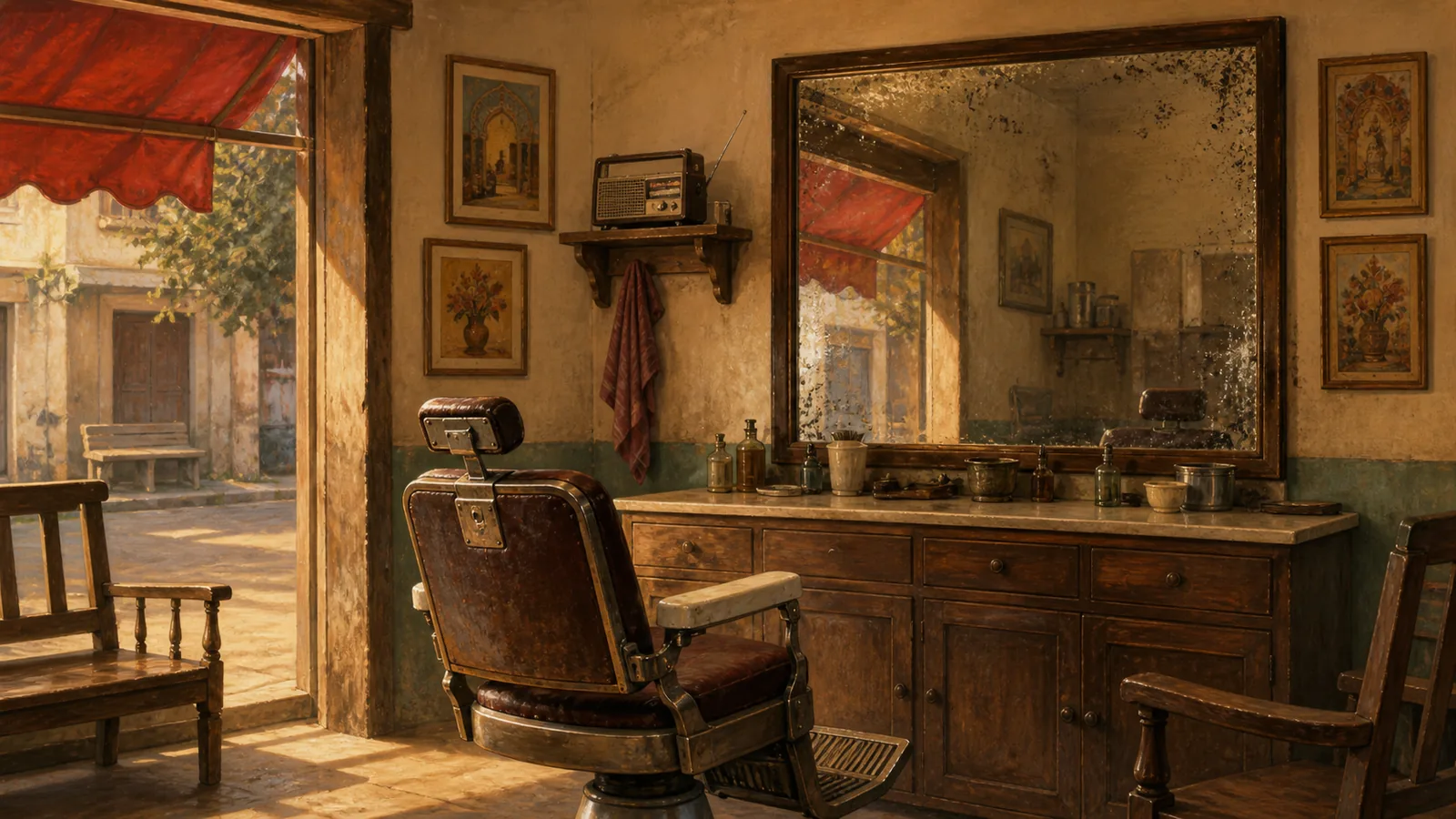
The site is a single screen. A painted street barbershop, red awning, two men mid shave, a fruit cart. A clock, a count of people online, a small glass player pill at the bottom. Around thirty songs play, and forty nine are catalogued.
The wordmark is the thing to notice. डीलक्स सैलून is set huge in white and skewed to sit along the angle of the shop's awning, so it reads as a painted sign rather than a page heading. That one choice is why the screenshot travelled.
It does nothing else. No song credits beyond what YouTube hands back, no tip jar, no rights note, no controls past play and skip. It is a mood, delivered fast, and we wrote about why that was enough to spread.
deluxesaloon.space, the one that did the homework
A different builder, @harsh_codess, made a site with almost the same name. It is far heavier.
It has 133 songs and it is a station, not a playlist, so what plays depends on the actual time in India. Shaadi and Sunday, शादी और इतवार, runs from five in the morning to nine. Saloon Classics covers the working day. 90s Dard, the heartbreak canon, comes on in the evening. Highway Raat takes over at ten. About a third of the catalogue sits in more than one rotation on purpose, so Chitthi Aayi Hai is in both Highway Raat and Saloon Classics.
Every track carries a written note in English and Hindi, with real credits for singer, composer and lyricist. The catalogue runs from Chitthi Aayi Hai in 1986 to Chaiyya Chaiyya in 1998.
It does not autoplay. You get a door instead, a button reading Enter the saloon, warning you it plays out loud. It is also the only site here that addresses rights, saying nothing is hosted and playback runs through YouTube's own player so labels get paid as normal. And it is the only one taking money, through Razorpay and Ko-fi, while telling you a tip buys nothing at all.
Why two sites are called Deluxe Saloon
They are separate projects by separate people. Early coverage mixed them up, and one search summary even credited deluxesaloon.space's features to Bhardwaj. They just reached for the same sign.
That sign looks like a spelling mistake to anyone outside India, and it is not one. Salon is French. English borrowed it and in 1728 produced saloon, meaning the same thing, a large room for receiving people. Both spellings coexisted for over a century, and the American sense of saloon as a bar only turns up around 1841. Indian English kept the older word, as Nigerian English also did. How exactly it stuck is not documented anywhere we found.
Deluxe is a class marker, used freely and without irony. On a state transport bus it is a literal fare class, meaning padded seats. A one chair shop with a cracked mirror calls itself Deluxe because the word is free and the aspiration is real. The gap between the sign and the shop is the joke, and a fond one.
busdriver.wtf, the biggest catalogue
Rajat built the bus. It is 227 songs, the largest catalogue of the lot, framed as a night run on NH 48 from Delhi to Mumbai. बस ड्राइवर in stacked Devanagari, हॉर्न ओके प्लीज़, a counter of how many people are aboard, and a palette like a highway under sodium lights.
The driver speaks in the first person. "I drive this bus. I pick every song on it." The closing line is the best writing in the whole wave: someone you know still knows every word to these, and there is room on the bus.
There is a catch. The artist field on all 227 tracks is the YouTube channel, not the performer, so Dil Ke Badle Sanam is by T-Series and Ho Gaya Hai Tujhko is by YRF. The commonest artists are all labels. Someone cared enough to tidy the song titles and not enough to fix the credits. It is also the only one built like a proper website, with inner pages for 90s hits, patriotic songs and Bhojpuri.
Why a barbershop and a bus, of all places
Because in both, you cannot change the music.
You are in the chair for twenty minutes with a cloth around your neck, and you did not pick the station. You go back every month for years, so the songs arrive attached to the smell of shaving foam and the mirror facing a mirror. On the bus the conductor's tape deck plays what the conductor wants, for hours, at everyone. One site labels its player कंडक्टर की टेप, the conductor's tape.
Music you choose splits people apart. Music played at you converges. If the barber, the conductor and the dhaba owner were all buying from the same cheap cassette catalogue, everyone who passed through those rooms heard the same thirty songs. That is why these sites work on strangers.
The bus carries its own affection. Maharashtra's state transport buses are called लाल परी, the red fairy, a name from 1960 when the fleet was repainted red. For much of rural Maharashtra it was the only reliable way out, and you do not call a bus a fairy unless it mattered.
nostalgiclist, the directory
While everyone else added another player, one project indexed them. nostalgiclist lists 18 sites and 549 songs by its own count, under the subtitle एक सफ़र · कुछ पुराने गाने, a journey and some old songs.
It does one thing nobody else does. Every entry has a build playlist button that turns that site into a real playlist on your own music account. It is the only thing here that leaves you holding something after you close the tab, which matters, because a browser tab has no offline mode and no background playback on a phone.
Below the directory sits a deck of dated history cards, from India's first commercial recording in 1902 to Gulshan Kumar starting Super Cassettes at a juice stall in 1983.
Two gaps. busdriver.wtf is not on it, so 18 undercounts, and it lists without judging, so you cannot tell an edited catalogue from a scraped one.
The other sixteen
The rest run from 6 to 48 songs each, all shipped inside about twelve days. Tamil town buses, a Vadodara garba site, a Pune Ganeshotsav mandap, two qawwali rooms that ended up with the same name, Rajasthani folk, Bengali, and a Haryana Roadways one written entirely in Devanagari. One, kassita.xyz, is Moroccan cassette nostalgia in Arabic, so the idea is not specific to India.
Three are different. nostalgiahits.in is a working Philips cassette recorder you poke at, with switches, knobs and a tape slot. haryanaroadways.wtf is a bus you drive, with a speed reading, a horn and a brake marked रोको. places-have-sound drops the desi frame for numbered soundscapes from anywhere. How these get built in a weekend is its own story, and the one page format has a long history predating the wave.
Which ones actually have visitors
Only two sites have published numbers. saloon.wtf's 1.6 million is views on the announcement post, not visits to the site. deluxesaloon.space showed 78,684 people tuned in when we looked on 12 August 2026.
Everything else is unknown. The live counters we could see that day were mostly single digits. Two sites showed one listener each. The busiest were 49, 24 and 14. If those are honest and concurrent, most of these sites have almost no audience, and what looks like a national craze is partly builders copying builders.
Which is fine. It is still the most fun twelve days the Indian web has had in a while.