Blog7 min read
What a Single Serving Website Is, and Why They Keep Returning
You open a link. A painted barbershop fills the screen. A song is already playing. No menu, no sign up box, no newsletter popup sliding in from the corner. There is one thing on the page, and it is already happening.
That is a single serving website. One page, one idea, no account. The name goes back to the late 2000s, and the form has outlasted most of the web fashions that arrived after it. The directory at singleservingsites.cool had 632 of them catalogued as of June 2026.
One page, one idea, no account
The definition is narrow on purpose. No second page, no login, no profile, no settings screen. You cannot save anything, and you are not asked for anything.
That sounds like a limitation. It is the entire appeal. A normal website spends your first thirty seconds explaining itself. A single serving site has nothing to explain, because the thing it does is the first thing you see.
The two families the form splits into
The first is ambient. These are places you leave open rather than things you use. Poolsuite FM plays retro summer radio inside a fake old operating system. Radiooooo lets you pick a country and a decade and hear its music. WindowSwap gives you ten minutes out of a stranger's window. Drive and Listen pairs dashcam footage of a city with its local radio, and Radio Garden is a spinning globe of live stations.
The second family is interactive, and its clearest example is neal.fun, a collection of 35 or more small toys including Infinite Craft and The Password Game. Its maker states the formula plainly. Take one concept, build the simplest possible system around it, skip the tutorial, and let depth come out of the mechanic rather than from piling on content.
The split matters. On an ambient site you listen, and what you share is the link. On an interactive site you do something, and what you share is your result. A result is different every time, so it gets shared again and again. A link gets shared once by each person, forever.
Why the form keeps coming back
A single serving site is the smallest complete thing you can put on the internet. No roadmap, no second phase, no accounts to support, no moderation queue. It is finished the day it ships. That makes it the natural shape for anyone building alone over a weekend, and that group grew once putting a working page online stopped requiring much code. The tooling behind this year's wave explains a lot about why so many appeared at once.
Why the 2026 desi nostalgia wave chose it
The wave of Indian nostalgia microsites that appeared in August 2026 is not a new genre. It is this one in a new language.
Of the twenty sites catalogued in the running list of desi nostalgia microsites, eighteen sit in the ambient family. Only two put you in charge of anything. nostalgiahits.in is a working Philips cassette recorder with knobs and switches you can actually turn. haryanaroadways.wtf is a bus driving simulation with a speedometer, a horn and a conductor's tape deck, captioned entirely in Devanagari.
The rest converged on one clean formula. The page is a single full screen illustration of a place. No layout, no sections, no scroll. The picture is the page. Everything functional floats on top as small furniture, and there are only four pieces: a clock set to IST, a live count of other people, a dark player pill, and links out to Spotify and YT Music. Removing the usual web furniture is what makes these read as objects rather than pages.
The "tuned in" counter
The most copied element in the wave is the least obvious one. Nearly every site tells you how many other people are on it right now.
saloon.wtf shows "30 online". deluxesaloon.space says "78,684 tuned in". A Tamil site called kudimagan says "49 kudimagans vibing with you". A town bus site counts "14 உடன் பயணிகள்", meaning fellow passengers. A ghazal site says "1 listening". haryanaroadways.wtf, in Devanagari numerals, will tell you there are zero passengers aboard.
Almost nobody writes "users" or "visitors". They write passengers, tuned in, listening, vibing with you. The counter is phrased in the language of the place the site is pretending to be, which is the cheapest way to make a fiction feel deeper. One garba site shows the city of the last arrival instead of a number, so the abstraction becomes a person somewhere in Vadodara.
Why a live number of strangers makes a page feel warm
It changes what kind of thing you are looking at. A page with one visitor is a document. A page that tells you thousands of others are hearing the same song right now is a station. The technology underneath is identical. The feeling is not.
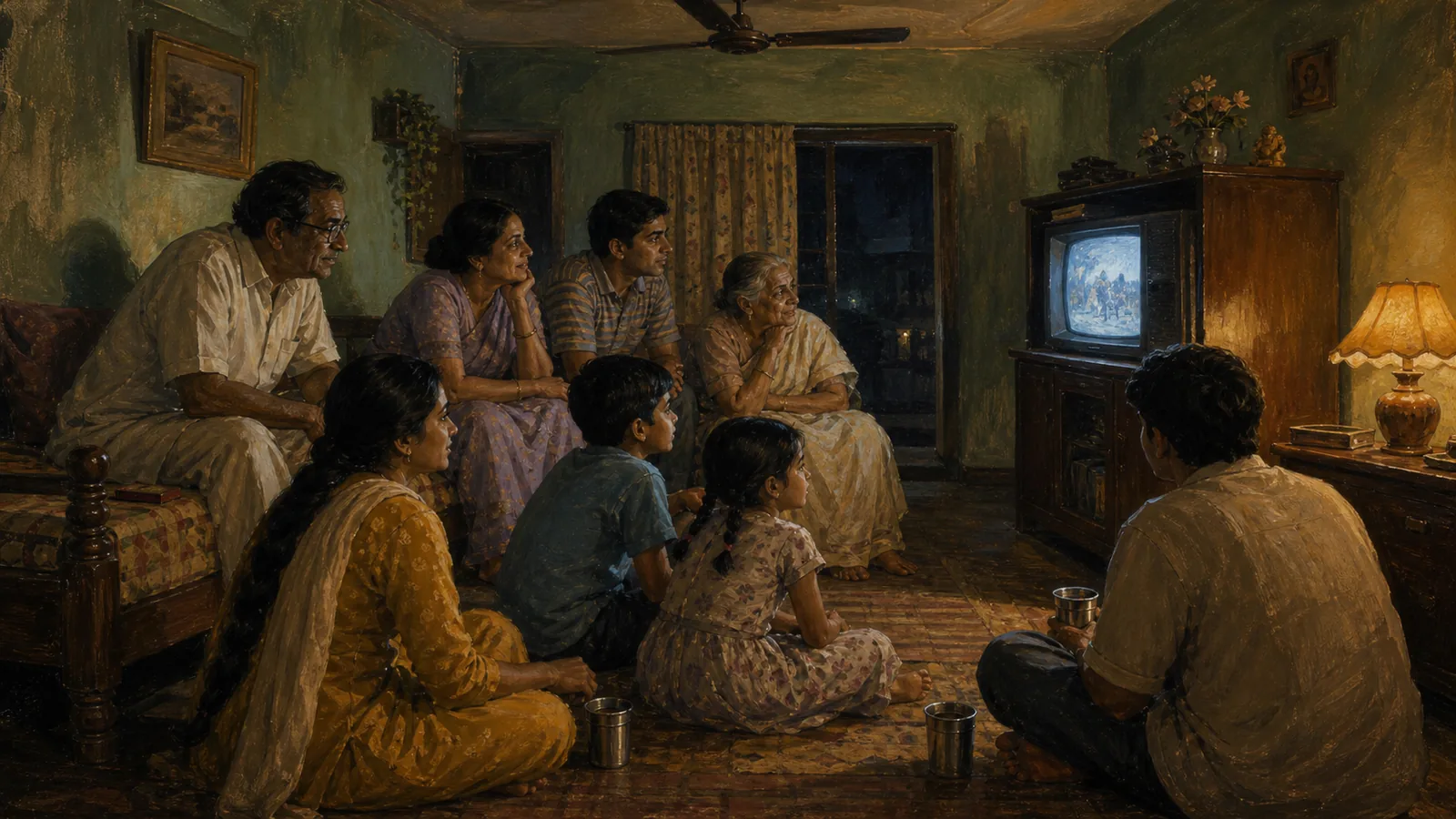
This lands hard for anyone raised on the Doordarshan Sunday schedule, where the whole country really was watching the same thing at the same time because there was nothing else on. That kind of listening was never private. It happened on buses, in shops, in one room with everyone in it. A solo browser tab breaks it. One line of text puts it back.
It costs almost nothing to build. A presence count needs a heartbeat and a number held in memory, with no accounts, no database and no moderation. Per line of code, it is the best value element in the genre.
The number is also unverifiable
Presence counters are trivially fakeable, and there is no way to check one from outside. A site showing one person online is at least plausibly honest. A large number is not checkable at all.
deluxesaloon.space's "78,684 tuned in" reads more like a running total than a count of people present right now, and the site does not say which it means. Treat it as self reported. Beyond that figure and saloon.wtf's post views, nobody has published audience numbers for these sites, so it is unclear how many people visited most of them.
Why the odd domain endings
Five sites in this wave share a top level domain: saloon.wtf, busdriver.wtf, truckplaylist.wtf, roadways.wtf and haryanaroadways.wtf. The first set the convention and the rest followed.
Part of it is availability. Exact name matches are far easier to get outside .com. One study of over 4,000 startups put exact match availability at roughly 85 percent on new domain endings against 54 percent on .com, and found 54 percent of startups now use a new ending as their main domain.
Part of it is a promise. A .wtf address tells you before the page loads that nothing is being sold and nobody wants your email. For a site with no account, that is the right signal.
The real function is tonal. Every good name in this wave pairs an absurd label with an object the builder plainly loves, and affection stated plainly is embarrassing to share. deluxesaloon.space reads as a project. saloon.wtf reads as a joke you are in on. The joke gives you cover while the sincerity gets through intact, so you can post it meaning "I love this" while appearing to post "lol".
There is a bill. A .wtf domain carries no search trust, it is awkward to say out loud, and it dates the project the way .io dated things in 2015. The tone suits disposable objects. The cost lands on anything meant to last, and the two most durable things this wave produced are not on .wtf.
What the form still cannot do
Ambient single serving sites have a consistent life. A sharp spike of attention, five to ten days of press, then almost nobody coming back. They become bookmarks nobody opens. The reasons these sites spread so fast are also the reasons they go quiet quickly.
The presence counter shows the ceiling most clearly. In every implementation it is read only. You can see that other people are there. You cannot wave at them, react to a song with them, or notice the room filling and emptying. Close the tab and the shared moment is gone. The wave found that co presence is powerful and then stopped at displaying it. Everything that would turn watching into taking part is still unbuilt.