Wiki6 min read
Binaca Geetmala by year: what the countdown was in any given year
Binaca Geetmala was a weekly countdown of Hindi film songs on the radio. It began in 1952 on Radio Ceylon, broadcasting out of Colombo, and it ran for about four decades.
Almost nobody searches for it by name alone. They search for it with a year attached. In India over the year to August 2026, the top searches around this show were Binaca Geetmala 1980, then 1970, then a phrase asking for the entire span, 1953 to 2000. The autocomplete suggestions run the same way: 1975, 1964, 1973, 1990, 1991, 1966.
So this page is built for the person typing a year. It covers what the show was in any year of its run, how the chart was put together, and what can and cannot honestly be said about the songs that led a particular one.
What Binaca Geetmala was, in every year it ran
A ranked list of Hindi film songs, played out on air, once a week.
That is the format, and it did not change much. The songs were the popular film songs of the moment. Between them the host talked, about the lyricist, the composer, the singer, and whatever story or struggle was attached to them. The talk was as much of the programme as the music.
The reason the show existed at all is stranger than the format. In 1952 India's own state radio decided to stop playing Hindi film songs, so the audience went to a station in another country to hear them. We have written that story out in full, along with the postcard habit that grew out of it, in our page on the song requests that made Jhumri Telaiya famous.
How the chart was ranked
Not by a panel of experts. By the audience, at least to begin with.
In its earlier years the chart was ordered by listeners' requests. Later it was ordered by record sales. That difference matters if you are trying to read a specific year. A high position in the early years tells you how many people sat down and wrote in about a song. A high position later tells you how many people bought the record.
Our research does not pin down the exact year the method changed, and we would rather say the join is fuzzy than draw a clean line we cannot defend.
The volume of post involved is worth pausing on. By the show's later years something like four hundred radio clubs and thousands of individual listeners were writing in every single day. All India Radio ended up printing standardised request postcards to cope.
How long it ran, and where it moved
Radio Ceylon carried it from 1952 to 1988. It then moved to All India Radio's own film music service, Vividh Bharati, from 1989 to 1994.
Same show, two homes. The move is a small piece of irony, because Vividh Bharati was launched on 3 October 1957 largely because India had lost its listeners and its advertisers to Colombo in the first place. The service is still on air today, and most people who search for it now simply want to listen to it right now, which we cover in our page on tuning in to Vividh Bharati online.
One thing to flag, because it sits right inside a popular search. People search for Binaca Geetmala 1953 to 2000. Our sources date the run from 1952 to 1994. We cannot account for the extra six years at the end, and we have not verified what, if anything, carried the name after 1994. If you have seen a source that settles it, that source is worth more than this paragraph.
Wednesday, and what a year of the show actually was
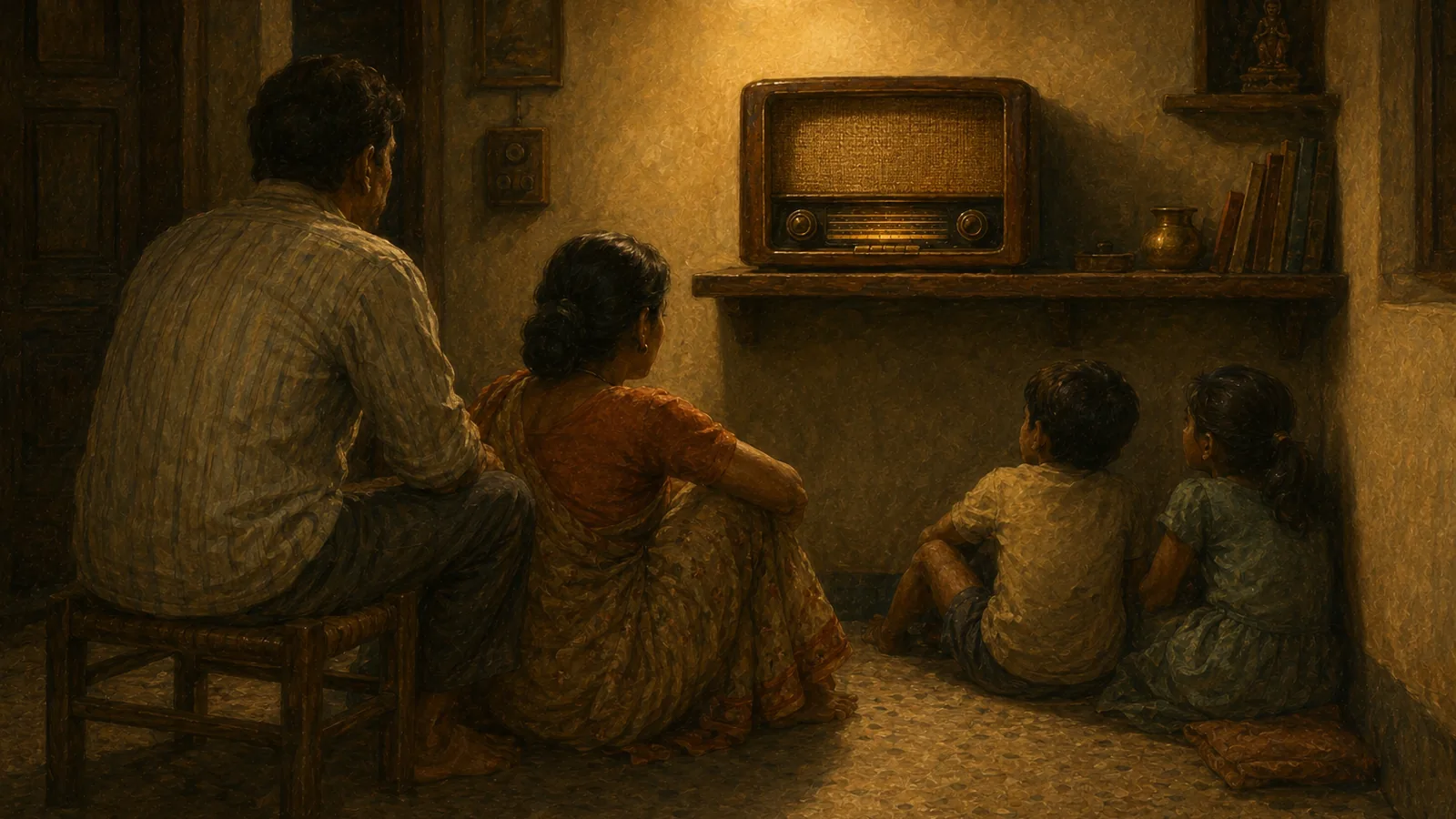
Wednesday became known in a lot of households as Geet Mala day.
That weekly rhythm is the part that shaped the memory. People argued in advance about which song would take the top spot, and placed bets on it. The chart was the week's small public event, and it arrived at a fixed hour.
Which leads to a point worth being clear about. A year of Binaca Geetmala was not one list published once. It was around fifty of these broadcasts, with songs climbing, holding and falling across them. When somebody asks what Binaca Geetmala 1980 was, the honest answer is that it was a year of weekly charts, not a single ranking.
What you can find out about one year, and what you cannot
You can find out plenty. For any year in the run you now know the format, the station, the host and the basis on which songs were ranked. All of that is above.
The one thing we cannot give you is the chart itself.
Our research flags this openly. The actual weekly rankings from 1952 to 1994 may be poorly digitised, and we have not verified a copy of them. So we are not going to publish a list of yearly number ones. A fabricated chart list is worse than no list at all, because it gets copied, quoted back and repeated until it looks like a record.
You will find such lists elsewhere. Fan compilations, YouTube playlist descriptions, forum posts, all of them stated with total confidence. Some may well be right. Before you trust one, ask where the numbers came from and whether you can check them. A confident list with no source behind it is still just a confident list.
In the meantime the songs themselves are easier to get at than the rankings. Our A to Z index of 90s Hindi songs will get you to the music of the show's final years, which is the stretch most people searching today actually lived through.
Why people remember it as a year in the first place
There is a reason nobody searches the bare name.
The show was not a thing you dipped into. It was the same appointment, week after week, for people who had few other ways of hearing new film music. So it stopped being a programme and became part of the calendar. You do not remember the countdown. You remember the year you were doing your exams, or the year you moved cities, with the countdown running through it.
That is also why the songs are shared. Nobody in the audience picked them, and everyone heard the same ones in the same week, an effect we have written about at more length in why everyone remembers the same songs.
The voice reading them out was Ameen Sayani, who joined Radio Ceylon in 1951 and presented the show for four decades. He opened every broadcast the same way, behno aur bhaiyo, aap ki khidmat mein Ameen Sayani ka adaab, sisters and brothers, at your service. He died in 2024 at ninety one. In the year to August 2026 he was the fastest rising related topic on Indian searches around this show, up 120 per cent. People looking up a year keep arriving at him, which is about right. For most listeners he was the show.