Wiki7 min read
Farmaish and Jhumri Telaiya: the radio song request
Farmaish is the Hindi and Urdu word for a request. On Indian radio it came to mean one very specific thing. You wrote to a station and asked for a particular song to be played, usually for somebody else, and then you sat next to the set at the right hour hoping to hear your own name said out loud by a stranger.
Millions of people did this for decades. One small town in what is now Jharkhand did it so relentlessly that its name turned into a national joke.
Why the requests went to Sri Lanka
The odd part of this story is that for years the most requested radio in India was not Indian.
In 1952 B. V. Keskar, the Information and Broadcasting Minister, decided that All India Radio should not play Hindi film songs. He thought them cheap and too Westernised. He began with a quota of ten per cent, talks with the Film Producers Guild of India collapsed, and All India Radio then stopped broadcasting film music altogether for years. There was a further rule that tells you everything about the mood of the time. If a film song did get played, the name of the film could not be announced, because that counted as advertising. Only the singer was credited.
The ban did not dent the music at all. It moved the audience across the water. Radio Ceylon, broadcasting from Colombo on a powerful shortwave transmitter the Americans had left behind after the war, started beaming Hindi film songs back into India. The country tuned to another nation to hear its own songs.
Out of that came Binaca Geetmala, a weekly countdown of Hindi film songs hosted by Ameen Sayani, who had joined Radio Ceylon in 1951. It ran on Radio Ceylon from 1952 to 1988, then moved to All India Radio's own film music service, Vividh Bharati, from 1989 to 1994. Wednesday became known in a lot of households as Geet Mala day.
How the request system worked
The chart was built from the audience. In its earlier years Binaca Geetmala ranked songs first by listeners' requests, and later by record sales. So sending in a farmaish was not just a wish. It was a vote that helped decide what the country heard the following week.
The volume got serious. By the show's later years, something like four hundred radio clubs and thousands of individual listeners were writing in every single day. All India Radio ended up printing standardised request postcards to cope with the flow, which is a strange and rather touching thing for a state to do. The government produced a stationery format for longing.
Requests were not confined to one programme. Vividh Bharati launched on 3 October 1957, largely because the state had lost both listeners and advertisers to Colombo, and its schedule was full of request based strands. Jaimala, running from 1964 and still going, plays film songs for armed forces personnel posted in hard places, introduced as songs for fauji bhaiyon ke liye, for our soldier brothers.
What a listener actually posted in
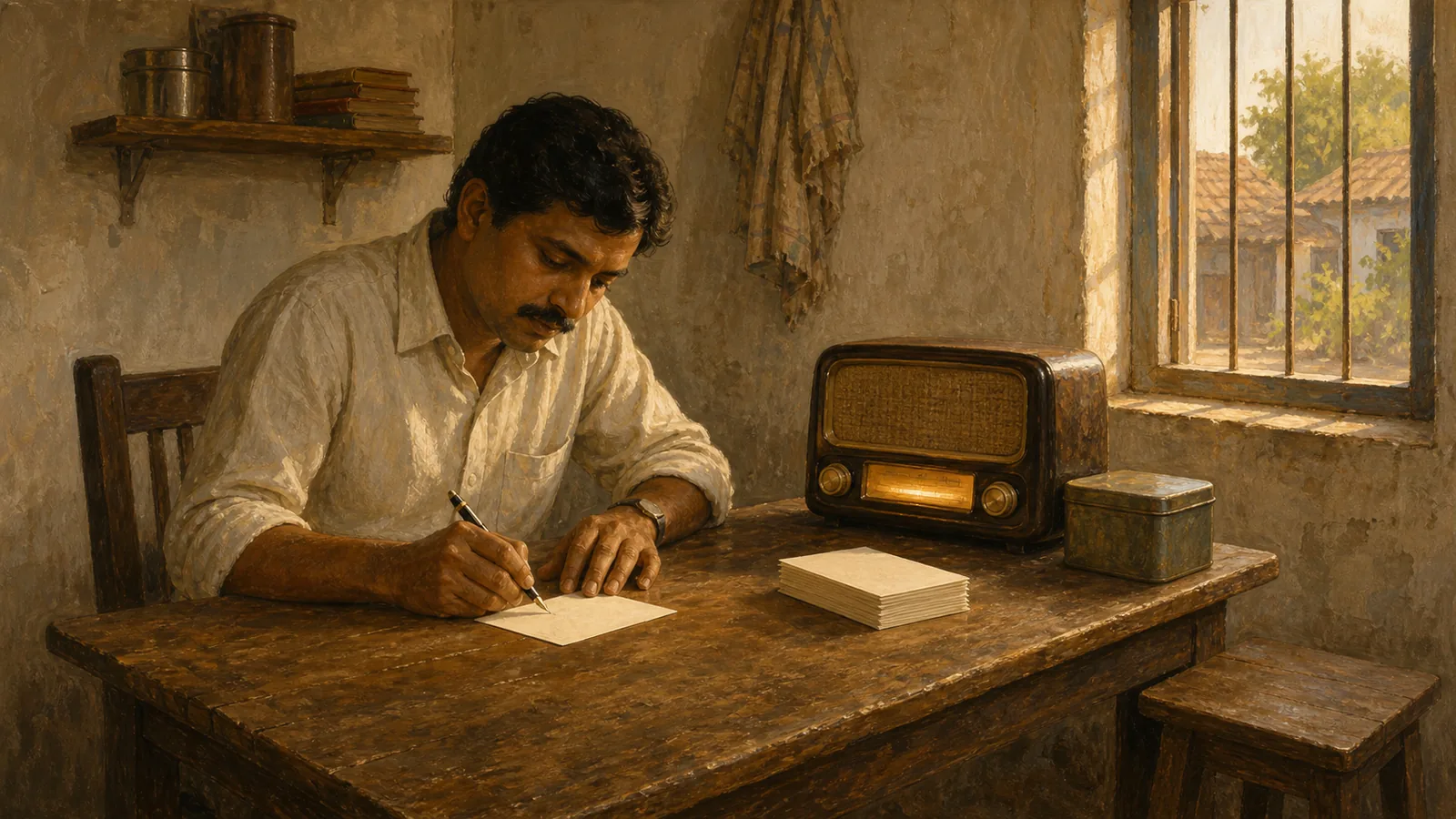
A postcard. The cheapest thing the post office sold, written on by hand and dropped in a box.
On it went the song you wanted, the name of the person you were sending it to, your own name, and your town. The town matters more than it looks, because it got read out along with the names.
Later, once the mail became unmanageable, All India Radio's printed request cards gave the whole thing a fixed shape. Our sources record that these standard cards existed, but not their exact layout, so we are not going to describe boxes and fields we have not seen. If you have one of these cards in a family drawer, it is a better source than anything written here.
How the names were read out
Ameen Sayani did not simply reel off a list. He opened with a greeting people can still quote from memory, behno aur bhaiyo, aap ki khidmat mein Ameen Sayani ka adaab, sisters and brothers, at your service. Then he worked around each song: the lyricist, the composer, the singer, some struggle or anecdote attached to them, and the requests that had brought it onto the chart.
That framing is the reason a farmaish landed the way it did. By the time your name arrived, the song already had a story wrapped around it, and your name went into the story. Listeners placed bets on which song would top the week. Sayani read letters, dedications and the tales inside them, which made him less a presenter than a correspondent for a very large and very scattered audience. He died in 2024, at ninety one.
The phrase that mattered most for this article was a routine one. Agli farmaish hai Jhumri Telaiya se. The next request is from Jhumri Telaiya.
Jhumri Telaiya
Jhumri Telaiya is a mica trading town in what is now Jharkhand. It is small, and it was never important in any national sense. It became famous purely for the number of song requests its residents mailed in.
The name came up on air so often that it entered ordinary speech as a stand in for somewhere impossibly far from anywhere. A town became national shorthand for the middle of nowhere because too many of its people were asking for songs for each other.
Why that town, and the two explanations
Nobody has settled this, and it is worth being straight about it.
The first explanation is about one man. Rameshwar Prasad Barnwal, a mica trader in the town, is usually credited with starting the habit, mailing postcards to Radio Ceylon almost daily. In this telling, a single obsessive listener created a local custom that others copied.
The second explanation is about the loop rather than the man. Informal listeners' clubs formed in the town, and residents began competing with one another over who could send the most requests in a day or a month. Once the town's name was being read out on national radio, sending a card became a way to be heard as a Jhumri Telaiya person, which produced more cards, which produced more mentions. The fame was the fuel.
These two accounts are not really enemies. The first explains how it started and the second explains why it did not stop, and most retellings run them together. What our sources do not do is prove that either was the deciding factor, or explain why the same thing did not happen in a hundred other small towns with radios and post offices. The mica trade is often hinted at as a cause, but the only firm link we have is that the man usually named as the originator happened to trade mica. Treat any confident one sentence answer to this question with suspicion.
Listeners were making the programme
Here is the part worth carrying away from all of this.
The most loved format in Indian broadcasting was assembled out of things the audience sent in. Ordinary people supplied the rankings, the dedications, the stories and, through the clubs, a fair amount of the show's energy. That is user generated content, running at national scale, decades before anyone had a phrase for it or a platform to put it on.
It is a useful contrast with what came later on television. The Doordarshan song programme Chitrahaar chose for you and could not be argued with, and the same is true of most of the grid we have reconstructed in our guide to the Doordarshan weekly schedule. Radio asked, television told. The shared memory that came out of both is much the same, and we have written about that in why everyone remembers the same songs.
There is also a reason so many of these requests carry an ache in them. A farmaish was usually posted across a distance, to a sister before her wedding, to a friend who had left for the army, to a son working in another state. The subject is separation as much as music, which is exactly the territory of the song Chitthi Aayi Hai, a letter from home to a man far away from it. People sent a song because they could not send themselves.