Wiki6 min read
Chitrahaar: the Doordarshan film song programme
Chitrahaar was a half hour programme of Hindi film song clips broadcast on Doordarshan, the Indian state television service. It first aired in 1982. For most of the years it ran, it was the main way an ordinary Indian household saw film songs at all, because there was nothing else on.
That last part is the whole point of the programme, and it is the part that is easiest to forget now.
What the name means
Chitrahaar is two Hindi words pushed together. Chitra means picture. Haar means garland. The name translates as a garland of pictures.
It is a good name because it describes the format exactly. The programme had no plot and no host doing links between items. It was a string of song sequences lifted out of films and threaded one after another, the way flowers are threaded on a string. You did not get the film. You got the song, the costumes, the sudden change of location between verses, and then the next one.
What was actually on it
Song sequences from Hindi films, cut from the films themselves. Thirty minutes of them.
The selection came from Doordarshan, not from the audience. Nobody voted, nobody phoned in, and nobody could skip to the next one. What was chosen was what you watched, and then it was over for a few days. This makes Chitrahaar different from the radio traditions that came before it, where listeners mailed in requests and heard their own names read out. That older habit is covered separately in our entry on the request slips that made Jhumri Telaiya famous, and it is worth reading alongside this one, because the contrast between a request show and a broadcast schedule explains a lot about how each is remembered.
When it was on
The commonly repeated schedule is 8 p.m. on Wednesdays and Fridays, on the national service. Thirty minutes each time.
Be careful with that, though. It is what most write-ups of the programme say, and it lines up with how a very large number of people remember their week. It is not the same thing as a broadcast log. Doordarshan's timings shifted across the years, regional stations did their own thing, and the programme outlasted several different versions of the channel around it. A slot that was true in 1986 was not necessarily true in 1996.
We have not found a primary listing that confirms the day and time year by year. Newspaper television pages from the period, or Prasar Bharati's own records, would settle it. Until somebody checks those, treat 8 p.m. Wednesday and Friday as the best available answer rather than the final one.
The end date is even less certain. Our research records the 1982 start clearly and does not record a clean finish. The programme carried on well past the 1990s in one form or another, so anyone telling you the exact date it stopped is probably guessing.
Why half an hour of songs was such a big deal
Because there was one channel.
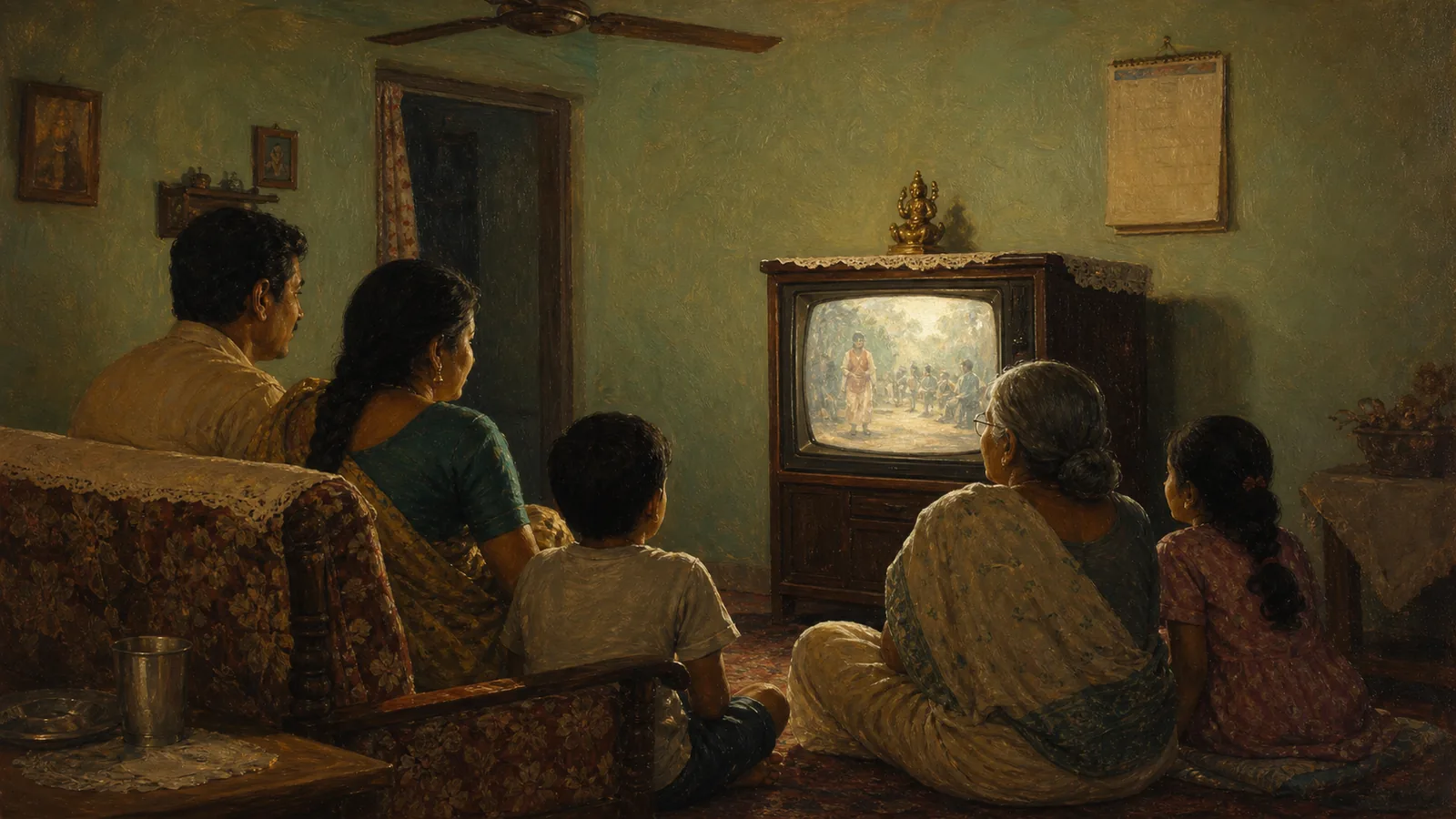
This is the fact that carries all the weight and the one that sounds least believable to anyone under thirty. For most of Chitrahaar's life there was no second option. No music channel, no video on demand, no phone in your hand. If you wanted to see a film song without buying a cinema ticket, you waited for the programme, and then you were in the room at the appointed time.
Thirty minutes is short. It was short then too. That scarcity is what made it feel like an event rather than background noise. Homework got abandoned. Dinner got moved. People who grew up with it describe arranging the evening around it in a way that is hard to explain to somebody who has never had to wait for a song.
The wider shape of that week, including the Sunday morning and Sunday evening blocks, is set out in our reconstruction of the Doordarshan weekly schedule. The nearest relative of Chitrahaar in that grid was the Sunday morning music programme Rangoli, which did a similar job at a different hour and is remembered just as strongly.
The songs nobody chose are the songs everybody knows
There is a reason a group of Indians of a certain age can sing the same songs without ever having agreed on them.
None of them picked those songs. Doordarshan picked, once, for everybody, at the same moment. Taste multiplies difference. Ask two people the same age from the same town for their favourite songs and you often get two lists with nothing in common. Ask them what was on Chitrahaar and you get overlap, because that part of their listening was issued to them rather than chosen.
We have written this argument out at more length in why everyone remembers the same songs. The short version is that involuntary listening produces shared memory in a way that chosen listening does not.
People disagree about the days, and they disagree with confidence
Anyone writing about Doordarshan schedules runs into this quickly.
In July 2026 a post on r/IndiaNostalgia, a subreddit of about 62,000 members, asked people to name their favourite programmes from 1990s Sunday television. Of the thirty eight visible replies, seven disputed a day or a time. One serial was placed on Monday by one person, on Friday by another, and at 9 p.m. by a third. Somebody moved another show from Sunday to Saturday. One commenter took apart the premise entirely, pointing out that the programmes shown together in the image never shared a schedule at all, because one belonged to the late 1980s and another only started after it had finished.
Those particular arguments were about the Sunday line up rather than Chitrahaar specifically. But they show the shape of the problem. Everyone was issued the same schedule, so everyone considers themselves an authority on it, and there is no room for taste to explain a disagreement. If your Wednesday and mine differ, one of us is simply wrong, and being right feels like proof that you were really there.
One more thing came out of that thread and it belongs here. Two people independently remembered the power going out during the programme. One ran home from school, switched the set on, and the light cut. Another said he watched whole serials only in the recaps, because the electricity failed most weeks. The appointment was kept by everybody except the supply. For a lot of households that is the sharper memory, and any account of this era that describes only the schedule working is telling half the story.
Where the archive sits now
The recordings belong to Prasar Bharati, the state broadcaster. DD Retro, the channel that existed to show this material, shut down on 31 March 2023. So the programme is enormously well remembered and currently has no proper home, which is a strange position for something this widely shared to be in.
A note on our own schedule
Where this site shows a Doordarshan style schedule and tunes itself to the clock, that schedule is a reasonable reconstruction. It is built from published accounts and from what people consistently remember, and it compresses more than a decade of shifting timings into one readable grid.
It is not a broadcast log and we are not going to pretend it is one. If you have period listings that correct it, they are worth more than anything written here.