Wiki6 min read
Rangoli, the Sunday morning song show on Doordarshan
Rangoli was a Hindi film song programme on Doordarshan. It went out on Sunday mornings, and for a great many Indian households it was the sound the weekend started with. There was no story to follow and no episode to catch up on. It was songs, one after another, playing out of the one television set in the house while everybody got on with the morning.
That is the whole show. It is also why people remember it the way they do.
What the programme was
The format was film songs, strung together and introduced. Doordarshan already had a show doing this on weeknights. Chitrahaar first aired in 1982, ran half an hour, and was on at 8pm on Wednesdays and Fridays. Its name means a garland of pictures, which is a fair description of what both programmes were.
Rangoli was the Sunday version of the same idea, and Sunday changed what it meant. A weeknight song show is something you catch after dinner. A Sunday morning song show is something that plays across the whole first half of the day, in a house where nobody is in a hurry.
Hema Malini hosted the early seasons.
When Rangoli aired, honestly
Sunday morning. If you want more precision than that, be careful, because the exact slot moved over the years and the people who remember it do not agree with each other.
That is not a small caveat. The Doordarshan Sunday most people picture is not one schedule at all. It is roughly a decade of schedules, from the late 1980s to the late 1990s, flattened into a single remembered morning. Programmes that never shared a year get filed into the same grid. Shows that went out on Saturday night get remembered as Sunday, because what is really being recalled is the weekend, with Sunday standing in for all of it.
So the sentence to trust is the loose one. Rangoli was on Sunday morning, in the stretch before the big serials, for most of the years people are thinking of. Anyone who hands you an exact time and a run of years without a broadcast log to back it is guessing with confidence. A fuller account of what can and cannot be pinned down is in the notes on the Doordarshan Sunday schedule.
Why Sunday morning mattered
Because there was one channel.
This is the part that is hard to explain to anybody who grew up after it. There was no second option, no other window, nothing else to switch to. What was on was what you watched, and every person you have ever met was watching the same thing at the same instant. Nobody chose the playlist. The playlist was issued.
Sunday was the day that arrangement was at its strongest. The morning ran to a shape the whole country knew. Krishi Darshan, the farming programme that has been going since 26 January 1967, sat early. Then came the serials that emptied the streets: Ramayan from 25 January 1987 to 31 July 1988, and Mahabharat from September 1988, at around nine in the morning. In the evening there was the Sunday film.
Rangoli lived in the run-up to all that. It was the part of the morning when the television was already on but nothing had started yet. That is a specific and slightly underrated position in a day. The show did not ask you to sit down. It filled the room while the room filled up.
What the house was doing while it played
Almost nothing to do with television.
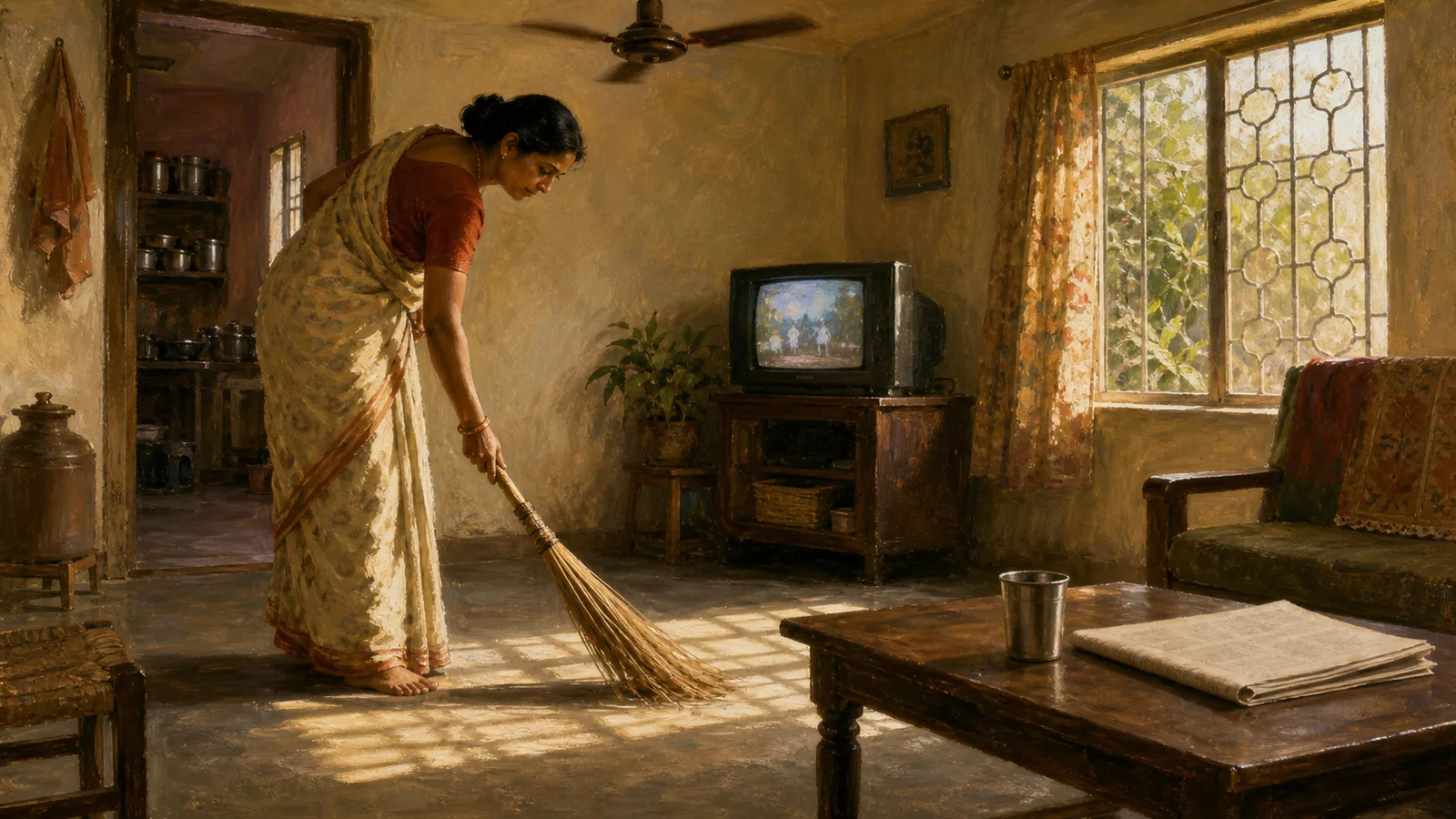
The floor was being swept and then washed. Vegetables were being cut. Somebody was oiling somebody else's hair, or having oil put in theirs and objecting. The pressure cooker was counting off its whistles from the kitchen. The newspaper was being read in parts and passed around in the wrong order. Children were being sent out for milk or bread and coming back slowly. Clothes that only got washed on Sunday were getting washed on Sunday.
The television was in the corner, on, and half watched. Somebody would look up when a song they liked came on, and shout the name of it, and go back to what they were doing.
That is why the recall is so physical. When people remember Rangoli they do not usually remember a performance. They remember the light coming through the grille of a window, the smell of the floor after it has been washed, the particular quiet of a morning with nowhere to be. The songs came attached to a room. This is also why a certain kind of song is lodged in a whole generation at once rather than in individual taste, which is what happened with Chitthi Aayi Hai. Nobody in that generation selected it. It was simply in the air of the house on a particular kind of morning, and it stayed.
The evidence that people hold it fondly
Here is one small measurement, and it is worth being clear that it is small.
In July 2026, someone on r/IndiaNostalgia, a Reddit forum with about 62,000 members, posted a picture of old Doordarshan shows and asked people to name their favourite. Thirty-eight visible comments came back. The most common thing people did was not reminisce. It was to add a title the post had left out, or to correct the day something was on.
Rangoli was the title volunteered most often as the missing one. Four separate people named it, unprompted, more than any other show. In a thread where the dominant instinct was to argue, Rangoli was the thing several strangers independently felt had been wronged by being left out.
One thread is not a survey, and recall at thirty years' distance is not a record of anything except what people believe. But as a measure of how a programme is held, four unprompted people insisting on the same absence is not nothing.
The other memory, which is the opposite one
Two people in the same thread remembered something else without being asked. One would run home, switch the set on, and the power would cut. Another said he watched whole serials only in their recaps, because the electricity failed every week.
The Sunday described above is the one that worked. For a lot of households the defining memory is the appointment that everybody kept except the supply. The absence was as widely shared as the programme was.
What is left of it
Not much that is easy to reach. DD Retro, the channel that existed to carry these archives, shut down on 31 March 2023. The material belongs to a state broadcaster and has no comfortable home online.
Which is roughly why, in August 2026, a wave of small websites rebuilding 1990s India from memory found an audience so quickly. That story is told separately in why the 90s nostalgia sites went viral. The short version is that the thing people are reaching for is not a programme. It is a morning.