Wiki7 min read
The audio cassette in India and what it changed
The audio cassette in India was a flat plastic box, two spools inside, a strip of brown magnetic tape running between them. From the early 1980s it was also the cheapest way to own recorded music the country had ever had. Almost everything else on this page follows from that price.
What the audio cassette was
A cassette had two sides, A and B. When one finished, you took it out, turned it over and pushed it back in. Lengths were measured in minutes of playing time, commonly sixty and ninety, sometimes a hundred and twenty.
Behind two small plastic windows you could see how much tape was left on each spool. That was your progress bar. Folded into the case was a paper inlay card with the film name and the song list on it, and a blank side where people wrote in ballpoint if the tape held something the printers had not planned for.
Tape came loose. The repair was a pencil pushed into a spool hole and turned by hand until the slack was wound back in. Anyone who owned tapes did this.
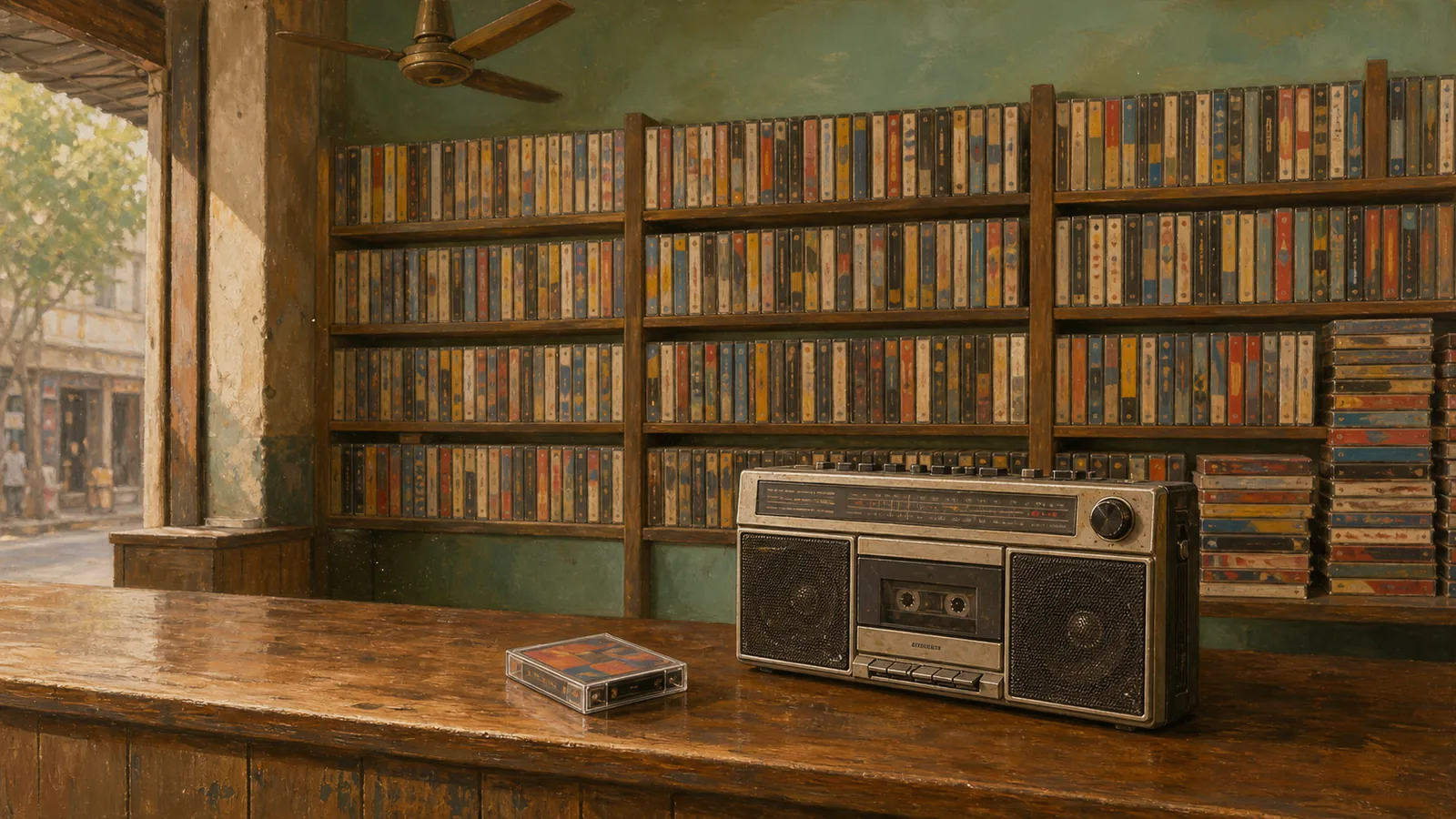
The machine at the other end was usually a two in one: a radio and a cassette deck in one plastic body with a carrying handle and a speaker grille. In a house it sat on a shelf. In a shop it sat wherever the wire reached.
Before 1983, recorded music was a luxury
Before that, recorded music in India meant a gramophone record, and records were expensive. The market was dominated by HMV, the Gramophone Company of India. Record shops were few and urban. Owning music was a middle class activity.
People still heard film songs, but somewhere other than at home: in the cinema, on the radio, or on television in the fixed slots the state broadcaster allowed. On television that mainly meant the half hour of film song clips called Chitrahaar, twice a week. On radio it meant sitting through an hour of other people's requests to catch one of your own, which is how a small town in Jharkhand became famous for sending in song requests.
In all of these, someone else decided. What the cassette introduced was a shopkeeper who could decide for himself what played, all day, at whoever walked in.
1983 and the price war
Gulshan Kumar was selling fruit juice in Delhi when he founded Super Cassettes Industries on 11 July 1983. The company became T-Series.
His method had two parts. First, price: he sold cassettes at roughly a third of what the originals cost. Second, catalogue: he issued thousands of re-recorded versions of old Hindi film songs whose rights sat with HMV, using the fair use provision of the Indian Copyright Act. This was contested in court and remains the disputed part of the story.
The result was quick and one sided. HMV's sales collapsed. By the middle of the 1980s cassettes held around 95 percent of the market. Industry revenue went from about 1.2 million dollars in 1980 to about 21 million in 1990.
The early T-Series catalogue was not prestige material. It was devotional music and the soundtracks of low budget films, aimed at rural and small town households that had never bought recorded music.
Gulshan Kumar was murdered in Mumbai in 1997. The company's history involves long running litigation and allegations about organised crime, and accounts of it differ in emphasis. This page does not try to settle that.
The shop
The cassette shop was often not a shop so much as a counter. Tapes stood on edge on shelves behind it, spines out, so you read a row of them like books. More were stacked flat in the corners. A two in one on the counter played whatever the owner had put on that morning, which doubled as advertising.
Many of these counters also recorded tapes to order. You bought a blank, named the songs you wanted, and the shop dubbed them onto it, sometimes writing the list on the inlay card by hand. This is one of the most repeated memories of the period, and our research has not turned up documentation of how the practice worked or how widespread it was, so treat it as recollection rather than a recorded fact.
The shelf that decided what a street heard
Cheap tapes changed where music lived. Once a cassette cost a third of a record, a barber could buy a shelf of them. So could a tea stall, a dhaba owner, a bus conductor, a truck driver.
The barbershop is the clearest case because it is so consistently described. In villages it was a wooden shed with a large mirror, an old wooden chair with an adjustable neck rest for shaving, and a worn cushion. In small towns it was two rows of seats, mirrors along the walls, calendar prints of gods and goddesses, and a television or a cheap sound system playing local hits.
That last item is the one that mattered. You are in the chair for twenty minutes with a cloth tied around your neck. You cannot leave and you cannot change what is playing. The barber's shelf was, for that street, the playlist.
Multiply that by a narrow catalogue sold cheaply everywhere at once and you do not get variety. You get convergence: the same songs, in the same kinds of rooms, across an enormous country. We have written separately about why a whole Indian generation remembers the same songs, and the barber's shelf is most of the answer.
Why a few composers own the decade
Ask people to name the sound of the Indian 1990s and the same names come back. The composer duo Nadeem Saifi and Shravan Rathod, working as Nadeem-Shravan, sit at the centre.
Aashiqui, released in 1990, is the hinge. Mahesh Bhatt built the film around its songs. Nadeem-Shravan composed, Kumar Sanu and Anuradha Paudwal sang, and the soundtrack became the best selling Hindi film album of its era. The template it set ran for the rest of the decade: melody first, romance, songs built to be sold on a cassette rather than seen in a cinema. Saajan, Dil Hai Ki Manta Nahin and Raja Hindustani follow the same shape.
Their arrangements suited the medium. Alongside the pop leaning material they wrote with tabla, veena and violin, instrumentation that survives a cheap speaker in a hot room. Music that still works on bad equipment ends up in barbershops.
One indication of how lopsided this was: a recent edited list of 133 songs, assembled to represent exactly this kind of public listening, credits 28 of them to Nadeem-Shravan, against 18 for Anu Malik, 18 for Jatin-Lalit and 13 for A. R. Rahman. On the singing side, Kumar Sanu and Alka Yagnik take 42 each, Udit Narayan 34, Lata Mangeshkar 20. That is one person's list rather than a sales chart, so treat it as an indication, but the shape of it matches what people remember.
Nadeem Saifi was later named in connection with the 1997 murder of Gulshan Kumar and left India. He was subsequently cleared. It ended the duo's run at the top.
This canon is usually dated from the 1986 Pankaj Udhas record Chitthi Aayi Hai out to Chaiyya Chaiyya in 1998.
The other thing tapes carried
A cassette records as easily as it plays, which made it useful for something other than music.
Through the 1980s and 1990s, Indians working in the Arab Gulf, many from Kerala and from Telugu speaking districts, posted voice recordings home on cassette instead of writing letters. A large number did this because they could not write. Families gathered around the recorder and talked into it together, then waited about a month for a tape to come back with the reply.
The same cheap object that carried film music into every barbershop was also carrying people's voices across an ocean.
After the tape
The cassette lost to the CD, the CD lost to the MP3 file, and the catalogue moved to the internet without much of it going missing. T-Series is now among the most subscribed channels on YouTube, holding the same songs. The company that made this music cheap enough to be everywhere in 1985 is the reason it is free to play in 2026.